
How Much Does an LED Video Wall Cost in India? What Goes Into the Quote
By Aaztec · Updated · about 11 min read
Short answer: there is no single per-square-foot price for an LED video wall in India. The cost is set mainly by pixel pitch (how many LEDs sit in each square foot), indoor or outdoor build, and what the quote includes: cabinets, controller, structure, power work, installation, spares, warranty and 18% GST. Compare quotes line by line, never by the headline figure.
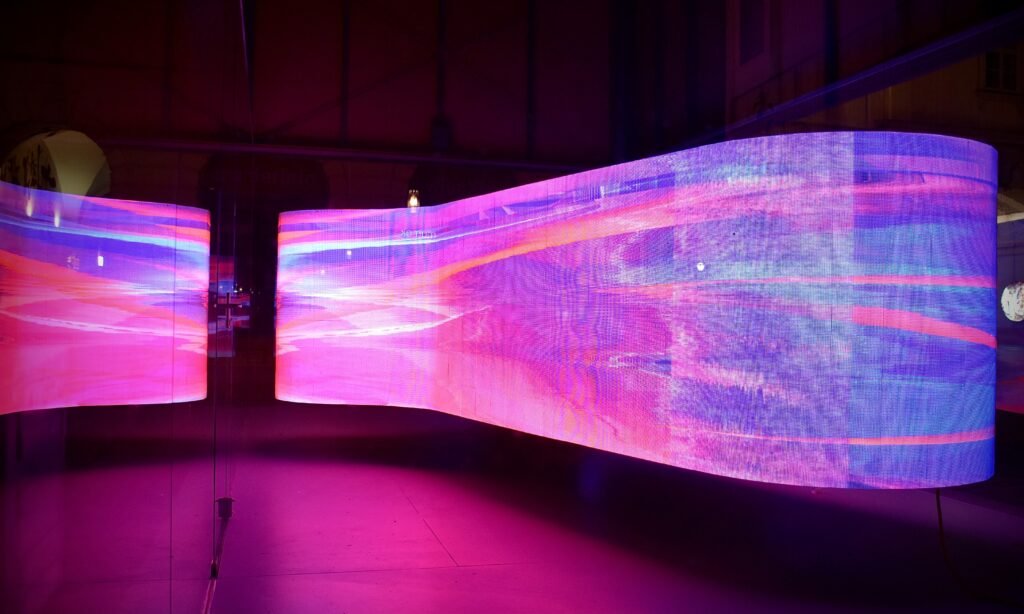
Photo: Arno Senoner via Unsplash
Key takeaways
- A P1.5 wall carries about 7 times as many pixels per square foot as a P4 wall. That is the biggest single reason fine-pitch walls cost more.
- A low per-sq-ft figure often leaves out the controller, mounting structure, electrical work, installation or GST. Ask for every line.
- Monitors under GST heading 8528 moved from 28% to 18% in September 2025. Check the HSN code and rate on your invoice.
- Outdoor walls cost more because of brightness, sealing and steelwork, not just size.
- If the wall will be filmed (studio, stage, live classes), ask for the refresh rate and test it with your own camera before you sign off.
Why do two quotes for the same LED wall differ so much?
Most people who ask us about price have already collected two or three quotes, and they are confused, sometimes a little annoyed. One figure looks like a bargain, another looks like a mistake. Usually neither is wrong. They are simply pricing different things.
When we went through Indian vendor pages in November 2026, per-square-foot figures for the same indoor pixel pitch varied several-fold. Some pages quoted per panel or per day without saying so, and most did not say whether the controller, structure, installation or GST was included. So the honest answer to “what does it cost?” starts with “what is in the quote?”.
An LED video wall is a large screen built from many identical LED cabinets bolted together, each cabinet holding several LED modules. A controller (sending card or video wall processor) feeds the picture, and receiving cards inside each cabinet light the right LEDs. Each of those parts has a cost, and each can be cheap or good.
What exactly are you paying for in an LED video wall quote?

Here is how a complete quote breaks down. Use it as a checklist: if a line is missing, ask whether it is included, extra, or your responsibility.
| Line item | What it is | What to ask |
|---|---|---|
| LED cabinets and modules | The screen itself, sold by area or by cabinet count | Pixel pitch, LED type (SMD or COB), brightness in nits, cabinet size and weight |
| Receiving and sending cards | The electronics that carry the picture to every module | Brand and model, and whether the cards are included in the per-sq-ft rate |
| Controller or processor | The box that takes HDMI or other inputs and maps them to the wall | How many inputs, 4K support, scaling, and whether you can show two sources at once |
| Mounting structure | Wall frame, floor stand, truss or outdoor steel | Who designs it, who checks the wall or roof can take the load, and whether civil work is extra |
| Power and data cabling | Distribution board, cabling, earthing | Is electrical work included up to the wall, or only from a point you provide? |
| Installation and calibration | Assembly, alignment, colour and brightness calibration | Days on site, and whether calibration is done after mounting |
| Media player and software | What plays your content and schedules it | Is a player included, and is any software licence yearly? |
| Spare modules | Extra modules from the same production batch | How many spares, and are they from the same batch so colours match later? |
| Warranty and AMC | Repairs after handover | Years covered, on-site or return-to-base, response time, and the AMC cost after warranty |
| Transport and GST | Freight to your site and tax | Freight included? Which HSN code and GST rate are on the invoice? |
If you want to see the range we build, our LED video wall price and range page lists indoor and outdoor options. We quote per project because these lines change with every site.
How does pixel pitch change the price?
Pixel pitch is the distance in millimetres from the centre of one pixel to the centre of the next. P2.5 means 2.5 mm. A smaller number packs more LEDs into each square foot, and every LED, driver chip and solder joint costs money. That is why pitch moves the price more than anything else.
The arithmetic is simple: one square foot is 304.8 mm on each side, so the pixel count is (304.8 ÷ pitch)². The table below is pure maths, not a price list, but it shows why a P1.5 wall cannot cost the same as a P4 wall.
| Pitch | Pixels per sq ft | Compared with P4 | Rough closest viewing distance | Distance where single pixels disappear (20/20 vision) |
|---|---|---|---|---|
| P1.5 | about 41,300 | 7.1× | 1.5 m | 5.2 m |
| P2.5 | about 14,900 | 2.6× | 2.5 m | 8.6 m |
| P3 | about 10,300 | 1.8× | 3 m | 10.3 m |
| P4 | about 5,800 | 1× | 4 m | 13.8 m |
| P6 | about 2,600 | 0.44× | 6 m | 20.6 m |
| P10 | about 930 | 0.16× | 10 m | 34.4 m |
The “rough closest” column uses the common one-metre-per-millimetre rule from our pixel pitch guide. The last column uses the visual acuity formula (pitch × 3,438 ÷ 1,000, in metres) published in an AVIXA article (updated August 2026). Rules of thumb vary between makers, so treat both as guides, not limits.
Pitch also decides resolution. To show a full HD picture (1920 × 1080) pixel for pixel, the wall has to be this big:
| Pitch | Wall size for 1920 × 1080 | In feet (approx.) |
|---|---|---|
| P1.5 | 2.88 m × 1.62 m | 9.4 × 5.3 ft |
| P2.5 | 4.80 m × 2.70 m | 15.7 × 8.9 ft |
| P3 | 5.76 m × 3.24 m | 18.9 × 10.6 ft |
| P4 | 7.68 m × 4.32 m | 25.2 × 14.2 ft |
Turned around, a 10 ft × 6 ft wall at P2.5 gives you about 1219 × 732 pixels, and at P1.5 about 2032 × 1219. Real walls are built from whole cabinets, so final sizes round to the cabinet grid. The practical lesson: choose pitch from where your nearest viewer sits and what they need to read, then size the wall. Paying for P1.5 in a hall where nobody sits closer than 8 metres buys detail no one will see.
Why does an outdoor LED wall cost more than an indoor one?
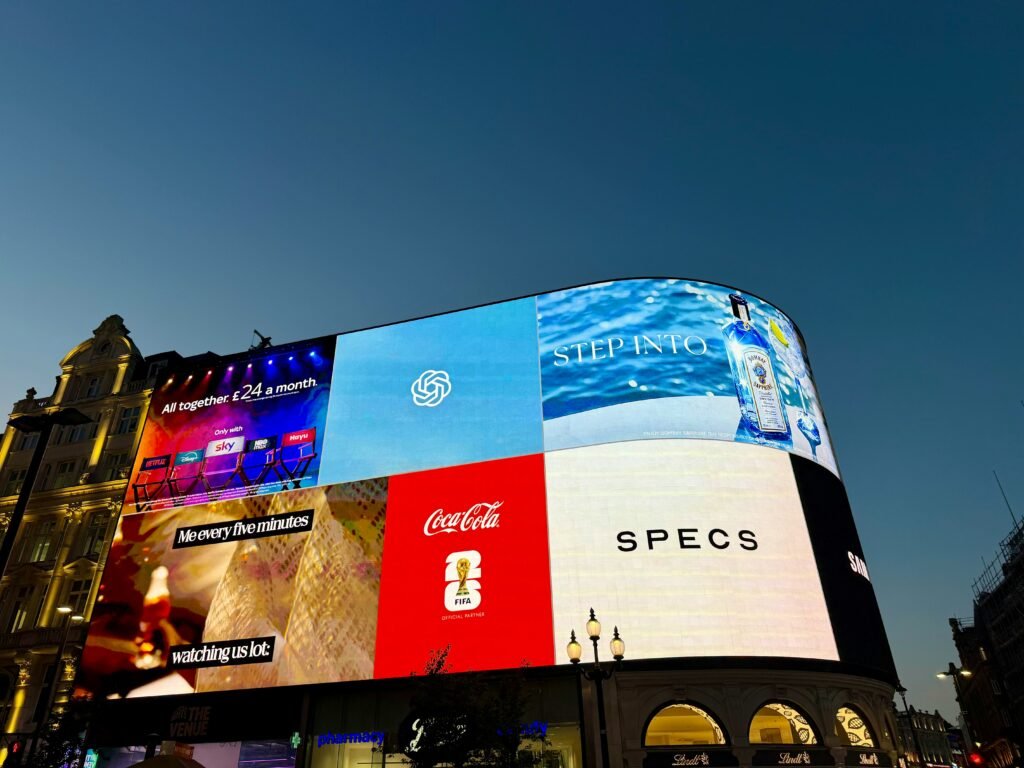
Photo: John Cameron via Unsplash
An outdoor wall fights the sun, the monsoon and heat all at once. Three things push its cost up:
- Brightness. Indoor screens are usually rated in the hundreds to about a thousand nits. Our ION indoor series is rated up to 1,000 nits, while our Shine outdoor series is rated up to 10,000 nits and the Shine Pro up to 7,500 nits. More light needs more power and better heat handling.
- Sealing. Outdoor cabinets need weather protection. The Shine series, for example, is IP67 rated front and rear in a 960 × 960 mm die-cast aluminium cabinet.
- Steel and civil work. A pole, rooftop or facade frame has to carry the screen and resist wind. This can be a large share of an outdoor quote, and it depends entirely on your site.
Brightness (a nit is one candela per square metre) is not a case of more is better indoors. A 10,000-nit screen in a conference room would be painful to look at. Match the rating to the room, and ask whether the wall can dim automatically at night.
Do you need a separate video wall controller?
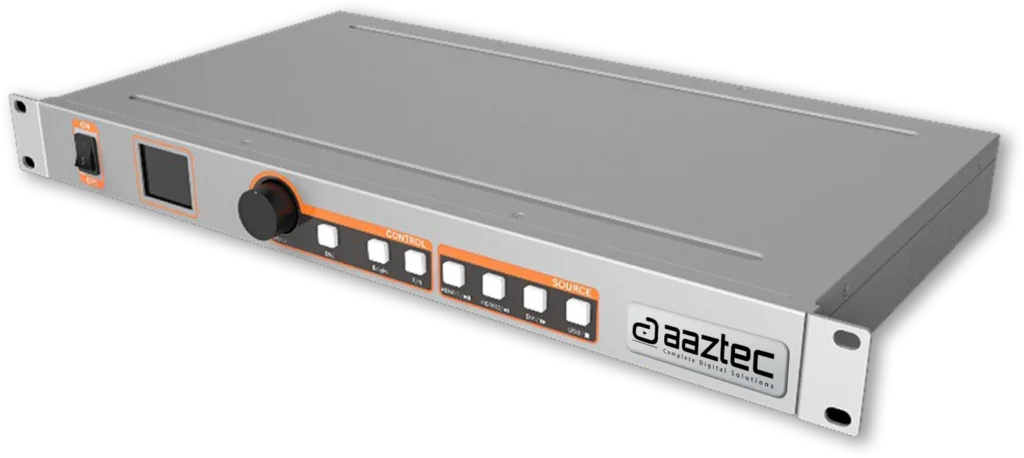
Every LED wall needs something to send it the picture. For a simple wall that plays one source, a sending card or an LED multimedia player may be enough. For a control room, auditorium or studio that switches between laptops, cameras and feeds, or shows several at once, you need a proper processor.
Ask two things: how many inputs you will plug in on a busy day, and whether you need to show more than one at a time (picture-in-picture or split layouts). Under-buying here is a common regret, because the wall itself is fine but switching sources is clumsy. Our video wall controller page explains the types in plain words.
Will the wall be filmed? Ask about refresh rate first
This matters a lot for studios, stages, churches, corporate events and online classes. An LED wall can look perfect to your eyes and still show dark rolling bands or flicker on camera. That happens when the camera’s shutter catches the LEDs between refresh cycles.
- Ask for the refresh rate in hertz. Our ION and Shine Pro series list 3,840 Hz.
- Ask what the rate is at the brightness you will actually run, not only at full brightness.
- Before final payment, film the wall with your own camera at the frame rate and shutter speed you will use. Phone cameras are a fair first test.
If you are planning a podcast or live-class set with an LED wall behind the presenter, think about the whole room together: lighting, acoustics and camera position decide the result as much as the screen.
What does an LED video wall cost to run each year?
The purchase price is only the start. Three running costs are worth estimating before you choose:
- Electricity. Datasheets list maximum and average power per square metre. Use the average. Example with an illustrative figure (not a spec): if a datasheet says 200 W per m² average, a 10 ft × 6 ft wall (5.57 m²) draws about 1.1 kW. Running 12 hours a day, that is about 13.4 kWh a day, or roughly 4,880 kWh a year. Multiply by your own tariff, and redo the sum with the figure on your quote.
- Spares and repairs. Single dead pixels and failed modules happen over the years. Spares from the same batch keep colours matched.
- AMC after warranty. Ask for the yearly AMC price in writing before you buy, not after the warranty ends.
Heat matters too. A wall in a closed room adds load to your air conditioning, and a hot cabinet ages faster. Ask how the cabinet sheds heat.
What changed in 2025 and 2026 that affects your quote?
- GST on monitors dropped to 18%. The GST Council’s 56th meeting (3 September 2025) moved heading 8528, which covers monitors and projectors not built to receive TV, from 28% to 18% (GST Council release). The new rates applied from 22 September 2025 (PIB). Many LED wall invoices use 8528, but classification depends on the product, so confirm the HSN code and rate with your supplier.
- BIS safety standard is changing. India has moved audio, video and IT equipment under its compulsory registration scheme to IS/IEC 62368-1:2023, replacing IS 13252 (Part 1) and IS 616. Old and new standards run side by side until 1 November 2028, as reported by testing body SIQ. We could not confirm whether every LED wall component falls under this scheme. If yours is imported, ask your supplier for the BIS registration number or a written reason it is not needed.
- Very fine pitch is still a premium product. TCL’s 163-inch 4K MicroLED TV, a home screen built like a very fine-pitch LED wall, launched in China in March 2026 at 249,999 yuan, about $36,000 (MicroLED-Info, 18 March 2026). Sub-millimetre walls are coming down in price, but they are not budget products yet.
- Big walls are going up in Indian cities. In August 2026 an operator unveiled a 586 m² 8K LED display on a tower in Hyderabad’s financial district (AV Interactive, 13 August 2026). Large outdoor walls are becoming normal, which is good news for service networks and spare parts.
Should you buy or rent an LED wall?
Rent when the wall is for a wedding, launch, conference or a single season. You pay for days, and setup, operation and removal come with it. Buy when the wall will run most days for years, such as in a showroom, auditorium, control room, studio or outdoor advertising site. If you are unsure, rent once for an event and watch how people use the screen. See our rental LED display services.
How do you compare two LED wall quotes fairly?
- Put both quotes in the same table, line by line, using the checklist above.
- Check the pitch, brightness, refresh rate and LED type are the same, not just the screen size.
- Convert both to the same unit: total cost for the finished, working wall at your site, including GST.
- Compare warranty terms and the written AMC price after warranty.
- Ask for a site visit or a live demo of the actual cabinet, and look at it from your nearest seat.
- Ask who you will call when a module fails, and how long a replacement takes to reach you.
A slightly higher quote that includes everything usually costs less in the end than a low one that grows extras after the order.
What we could not confirm
We have kept this guide free of rupee price bands on purpose. Published Indian figures for the same pitch vary widely and rarely say what is included, so printing them would mislead more than help. We also could not confirm a single GST heading for every LED wall product, or whether every component needs BIS registration. Ask your supplier to put both in writing. The power example above uses an illustrative wattage, not a measured one.
Frequently asked questions
How much does an LED video wall cost per square foot in India?
It depends mainly on pixel pitch, indoor or outdoor build, and what the quote includes. Per-square-foot figures published online vary several-fold for the same pitch and often leave out the controller, structure, installation or GST. Ask for an itemised quote for the finished wall at your site.
Why is a P1.5 LED wall so much more expensive than a P4 wall?
A P1.5 wall carries about 41,300 pixels per square foot, against about 5,800 for P4, roughly seven times as many LEDs, driver chips and solder joints. The extra sharpness only pays off when viewers sit close.
What is the GST rate on an LED video wall?
Monitors under heading 8528 moved from 28% to 18% GST from 22 September 2025. Many LED wall invoices use this heading, but classification depends on the product, so confirm the HSN code and rate on your invoice.
What should an LED video wall quote include?
LED cabinets and modules, receiving and sending cards, a controller or processor, mounting structure, power and data cabling, installation and calibration, a media player, spare modules, warranty and AMC terms, freight and GST.
What refresh rate does an LED wall need if it will be filmed?
A high refresh rate reduces flicker and rolling bands on camera. Aaztec’s ION and Shine Pro series list 3,840 Hz. Always film the wall with your own camera settings before final payment.
Is it cheaper to rent or buy an LED video wall?
Renting is usually better for one-off events because setup and removal are included. Buying makes sense when the wall will run most days for years, as in showrooms, auditoriums, studios or outdoor advertising.
Sources: GST Council, 56th meeting release (3 Sep 2025); PIB on the 22 Sep 2025 effective date; SIQ on IS/IEC 62368-1:2023 migration (16 Dec 2025); AVIXA, choosing pixel pitch; MicroLED-Info (18 Mar 2026); AV Interactive (13 Aug 2026); Aaztec product pages for ION, Shine and Shine Pro specifications.