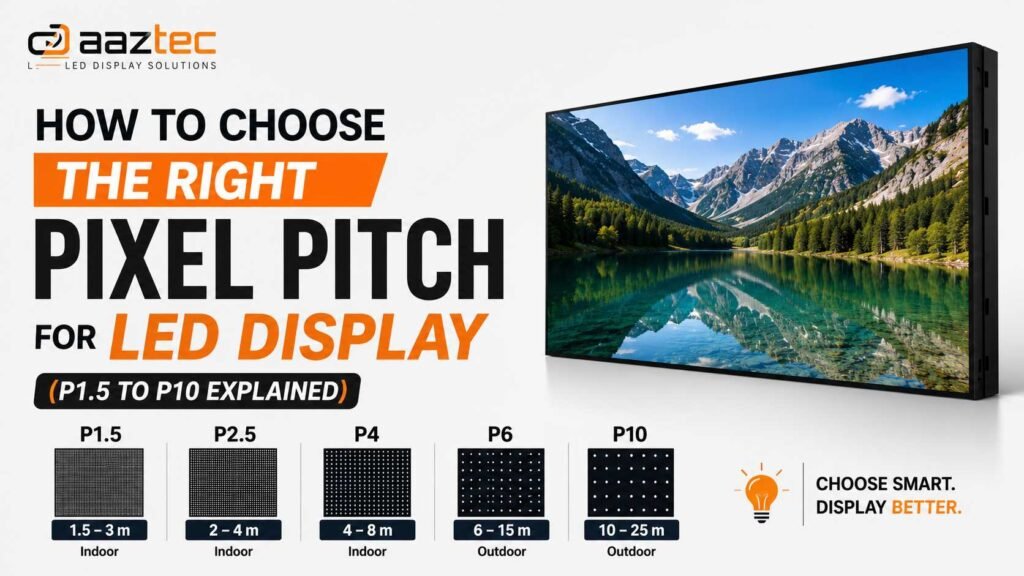
If you have ever asked a vendor about an LED screen and heard the term “pixel pitch” thrown around without explanation, you are not alone. Most first-time buyers do not know how to choose the correct pixel pitch for LED display projects, and this single decision affects everything else — image sharpness, viewing distance, brightness, and even the final price. This guide breaks down pixel pitch in plain language, so you can choose confidently instead of guessing.
Pixel pitch is simply the distance, measured in millimetres, between the centre of one LED pixel and the centre of the next pixel on the panel. It is written as P1.5, P2.5, P4, P6, P10 and so on. The number tells you how tightly packed the LEDs are.
A smaller number means the LEDs are closer together, which creates a sharper, more detailed image when viewed up close. A larger number means the LEDs are more spread out, which is fine for a screen that will be viewed from far away, like a highway hoarding.
Choosing the wrong pixel pitch leads to two common problems. If the pitch is too large for a close viewing distance, viewers will actually see the individual dots or pixels on the screen, making the image look grainy instead of smooth. If the pitch is too small for a large viewing distance, you end up paying extra for sharpness that no one standing far away will ever notice.
There is a simple general rule used across the industry: the minimum viewing distance in metres is roughly equal to the pixel pitch in millimetres. So a P4 screen is comfortably viewed from about 4 metres or more, while a P1.5 screen is designed for viewing from as close as 1.5 metres.
Here is a breakdown of common pixel pitch for LED display options and where they are typically used:
P1.2 to P1.9 (Fine Pitch)
Ideal viewing distance: Under 2 metres
Best for: Control rooms, TV broadcast studios, premium retail displays, corporate command centres
Why: These environments need extremely sharp, close-up detail since viewers or cameras are positioned very close to the screen.
P2.5 to P3
Ideal viewing distance: 2 to 4 metres
Best for: Corporate lobbies, conference rooms, boardrooms, upscale retail branding walls
Why: This range balances high image quality with a more reasonable price than fine pitch, suited to indoor professional spaces.
P4
Ideal viewing distance: 4 to 6 metres
Best for: Auditoriums, banquet halls, wedding stages, exhibition booths
Why: This is the most popular choice for events, since most audiences sit a few metres back and it offers a good balance of clarity and cost.
P6
Ideal viewing distance: 6 to 10 metres
Best for: Large indoor halls, semi-outdoor stages, big event backdrops
Why: Slightly more budget-friendly than P4 while still looking sharp for medium to large gatherings.
P8 to P10
Ideal viewing distance: 10 metres and beyond
Best for: Outdoor hoardings, stadium screens, highway advertising displays
Why: At this distance, the human eye cannot distinguish individual pixels, so a wider pitch works perfectly while keeping costs manageable for very large screen sizes.
Yes. Indoor screens are usually viewed at closer range in controlled lighting, so a finer pixel pitch for LED, such as P2.5 or P4, is common indoors. Outdoor screens need to compete with sunlight and are usually viewed from farther away, so pitches like P6 to P10 are standard, combined with much higher brightness levels and weatherproof cabinets.

Larger screens can afford a wider pixel pitch because viewers naturally stand farther back to see the whole picture. Smaller screens meant for close interaction, like an information kiosk or a reception desk display, need a finer pixel pitch to stay sharp since viewers stand close to them. As a rule, always match pixel pitch to actual viewing distance rather than screen size alone.
Choosing too fine a pitch for a large outdoor hoarding means paying significantly more money for detail that no one on the road will notice from 30 metres away. Choosing too wide a pitch for an indoor boardroom means executives sitting a few feet away will see a grainy, dotted image instead of a clean, professional display. Both mistakes are common among first-time buyers who focus only on price or screen size without considering pixel pitch for LED display and its relationship to viewing distance.
Yes, to some extent. If your screen will mostly display large bold text, logos, or simple graphics viewed from a distance, a slightly wider pixel pitch works fine. But if your screen will show detailed video content, small text, or high-resolution photography viewed up close — like a product showcase or a broadcast studio backdrop — a finer pixel pitch for LED display becomes essential for the content to look sharp and professional.
When you are stuck between two nearby options, consider your typical viewing distance and budget together. If most viewers will be standing right at the edge of the recommended range, it is usually safer to choose the finer pitch, since a slightly sharper image is always more forgiving than a slightly grainier one. If budget is tight and viewers will mostly be seated farther back, the wider pitch of the two is a reasonable, cost-effective choice.
Choosing the right pixel pitch for LED display comes down to one simple question — how close will your audience actually be? Once you know your viewing distance, indoor or outdoor environment, and content type, matching the correct pixel pitch becomes straightforward. Getting this right ensures your screen looks sharp, professional, and worth every rupee spent, instead of either wasting money on unnecessary detail or ending up with a grainy, unclear display.
Still unsure which pixel pitch is right for your venue? Talk to the LED display specialists at Aaztec for expert guidance tailored to your space, budget, and audience.
For More Information
Visit Our Website- Aaztec
Contact us at – Aaztec
P3 to P4 is generally the best choice for wedding halls and banquet stages, since guests typically sit a few metres away from the screen.
P8 to P10 is standard for outdoor advertising hoardings viewed from a distance, along with weatherproof, high-brightness panels.
Not necessarily. A smaller pixel pitch is sharper up close but costs more, and offers no visible benefit if your audience is viewing the screen from a distance.
No, a single LED display uses one consistent pixel pitch throughout, since panels are built as uniform modules that combine into the full screen.