
LED Wall vs Projector for Auditoriums, Conference Rooms and Events: Which One Should You Choose?
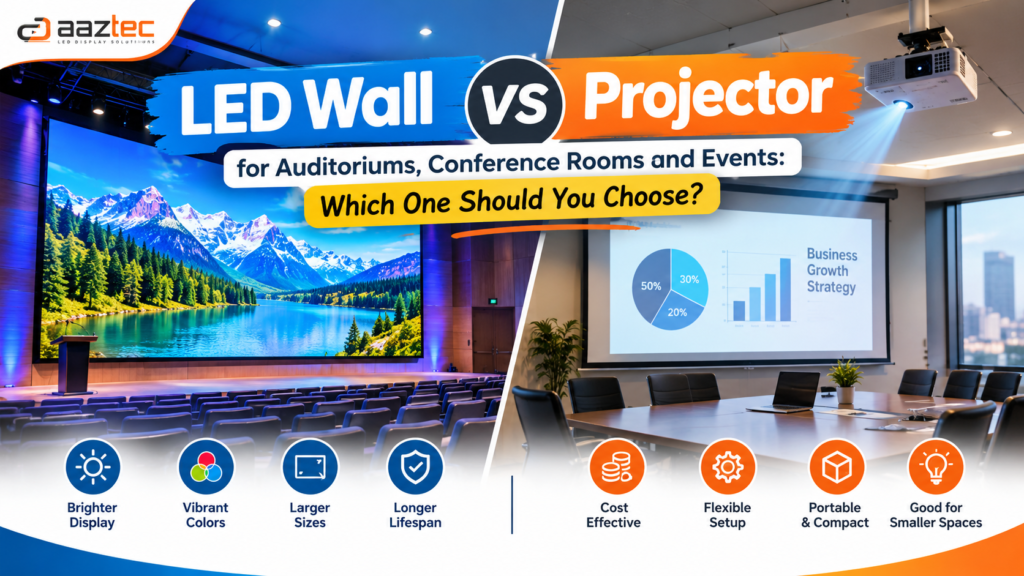
What is the main difference between an LED wall and a projector?
An LED wall makes its own light, while a projector throws light onto a screen. An LED wall is built from small panels (cabinets) joined together to form one big display. A projector sends an image from a lens to a separate surface.
This single difference explains most of the pros and cons. Because an LED video wall creates its own light, it stays bright and sharp even when the room lights are on. A projector needs a dim room, or the picture looks washed out.
The LED screen vs projector choice is also about how you use the space. A projector is a lighter, cheaper starting point. An LED wall is a longer-term investment in picture quality.
At Aaztec, we manufacture LED video walls for indoor and outdoor use, so we see both setups in real venues every week. The answer always depends on room size, light and budget.
Which is better for auditoriums?
For most medium and large auditoriums, an LED wall is the better choice because it stays bright, clear and easy to see from every seat. Projectors can still work in smaller halls with good light control.
Here is why LED walls usually win in auditoriums:
- Brightness: Stage lights and spill light do not wash out the image.
- Wide viewing angle: People sitting at the sides still see a clear picture.
- Any shape or size: Panels can be built to match your stage design, including curved layouts.
- No shadows: Speakers can walk in front of the screen without blocking the image.
A projector is still a fair choice if the hall is small, fully dark and used only for slides. Check the throw distance and seating layout before you decide.
For long-term venues like colleges, large halls and theatres, see our indoor LED display range. Education buyers can also look at our digital displays for education.
Which is better for conference rooms?
For small and medium conference rooms, a projector or an LED panel can both work, but fine-pitch LED gives the best picture for daily meetings. Projectors work when budget is tight and lights can be dimmed.
Many office teams now prefer a display that works in normal room light. Here is how the options compare:
- Projector: Low upfront cost, but it needs dim lights, a clean screen and regular lamp or laser checks.
- Fine-pitch LED wall: Sharp text, strong colour and no lamp replacement. It suits boardrooms and video calls.
- Interactive flat panel: A good fit for small huddle rooms where people write and share on the screen. See our Interactive Flat Panel (IFP) range.
If you often run hybrid meetings, a bright and sharp display makes remote participants easier to see and read. Projectors can struggle with fine spreadsheet text in bright rooms.
Explore our corporate display solutions to see how offices are using LED today.
Which is better for events?
For concerts, weddings, launches and exhibitions, an LED wall is usually the better choice because it works in daylight, handles big sizes and looks sharper on camera. Projectors suit small, dark indoor events only.
Event screens face harder conditions than offices. Lights change, crowds are large and cameras are often recording. An LED wall gives:
- High brightness for hotel halls, open lawns and daytime events
- Camera-friendly visuals with less flicker on video
- Flexible sizes that you can plan to the stage
- Quick setup with modular panels
You do not have to buy for a one-time event. Renting is often smarter. Aaztec offers rental LED display services with setup, an on-site technician and dismantling included, across Delhi NCR, Lucknow, Chandigarh, Dehradun and other North Indian cities.
For outdoor events, check our weather-resistant outdoor LED displays. Projectors are a poor choice outdoors in daylight.
LED wall vs Projector
An LED wall wins on brightness, lifespan and flexibility, while a projector wins on upfront cost and portability. The table below sums it up.
| Feature | LED Wall | Projector |
|---|---|---|
| Brightness in lit rooms | Very good | Weak, needs dim light |
| Picture sharpness | Excellent with fine pitch | Good in dark rooms |
| Viewing angle | Wide | Limited by screen type |
| Screen size and shape | Fully custom | Limited by throw distance |
| Upfront cost | Higher | Lower |
| Maintenance | Low | Lamp or laser care, filters |
| Lifespan | Long | Shorter |
| Shadows from people | None | Yes |
| Outdoor use | Yes (IP65 models) | Not suitable in daylight |
| Best for | Auditoriums, events, boardrooms | Small dark rooms, budget setups |
How much does each option cost over time?
A projector costs less to buy, but an LED wall often costs less over many years because it needs fewer replacement parts and lasts longer.
Think about the full cost, not just the first bill:
- Projector: Lower purchase price, plus a screen, ceiling mount, lamp or laser servicing and sometimes room blackout work.
- LED wall: Higher purchase price, but no lamps, no screen cloth and little upkeep.
- Energy use: Modern LED panels are efficient. The Bureau of Energy Efficiency, a government body, shares guidance on energy-efficient equipment at beeindia.gov.in.
Aaztec lists indoor P2.5 LED video walls from around ₹1,20,000 onward, with final price depending on size and pixel pitch. Every permanent installation comes with a 3-year warranty, and AMC plans are available after that. Visit our LED video wall page for options, or request a free quote.
Always buy from a supplier who gives a proper GST invoice and warranty card.
How do you choose the right one?
Choose by checking five things: room light, audience size, viewing distance, budget and how often you use the screen.
Use this simple checklist:
- Room light: Bright or mixed light means LED. A fully dark room means a projector can work.
- Audience size: More than 100 people usually points to an LED wall.
- Viewing distance: Close viewers need a smaller pixel pitch (like P1.5 to P2.5). Far viewers can use P3 or higher.
- Budget: Short-term budget favours a projector or rental. Long-term value favours LED.
- Usage: Daily use benefits from LED reliability. Occasional use may suit a projector.
For multi-screen setups, a video wall controller helps you manage content smoothly. You can also read our case studies to see real installations, or learn more about Aaztec.
Safety also matters. Check that electrical products follow Indian standards from the Bureau of Indian Standards.
Final Thoughts
For auditoriums, conference rooms and events, an LED wall is the stronger long-term choice in most cases, while a projector remains a sensible budget option for small, dark rooms. If you are unsure, tell us your room size, lighting and use case, and Aaztec will suggest the right setup.
Frequently Asked Questions (FAQs)
Is an LED wall better than a projector for auditoriums?
Yes, for most medium and large halls. An LED wall stays bright under stage lights and gives a clear picture from every seat. A projector only suits small, dark halls.
Can a projector work in a bright conference room?
Only weakly. Projector images wash out in bright light. A fine-pitch LED display or an interactive flat panel is a better fit.
Is LED wall rental better than buying for one event?
For a one-time event, yes. Rental covers setup, a technician and removal, so you avoid buying equipment you will not use again.
Which lasts longer, an LED wall or a projector?
An LED wall generally lasts longer because it has no lamp to replace and no screen cloth to wear out.
Which lasts longer, an LED wall or a projector?
Match it to viewing distance. Closer viewers need smaller numbers (P1.5 to P2.5). Larger halls and outdoor events can use P3 to P6 or higher.