
Smart Classroom Requirements: A National Education Day Checklist for Indian Schools
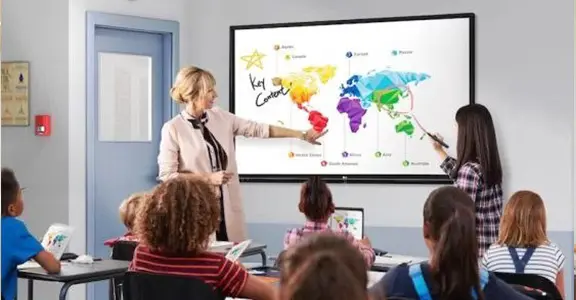
Why talk about smart classrooms on National Education Day?
Every year on 11 November, India marks National Education Day on the birth anniversary of Maulana Abul Kalam Azad, independent India’s first Education Minister (Ministry of Education explainer, PIB). It is a good day to ask a practical question that many principals and trust members are asking right now: what does a classroom actually need before a digital board can make a real difference?
It is easy to picture how it goes wrong. A panel arrives with great excitement, and a few months later it is used as a very large television, because nobody planned the power, the internet, the content or the teacher training. That would be heartbreaking for the teachers who wanted it most. This checklist is meant to prevent it.
Where Indian schools stand today: the official numbers
The Ministry of Education released the UDISE+ 2025-26 report on 7 July 2026 (PIB release ID 2282141). Its figures on the basics a smart classroom depends on are encouraging, and also a reminder of how far there is still to go:
| Share of schools with | 2022-23 | 2023-24 | 2024-25 | 2025-26 |
|---|---|---|---|---|
| Electricity | 91.7% | 91.8% | 93.6% | 95.0% |
| Computer access | 47.7% | 57.2% | 64.7% | 69.9% |
| Internet facility | 49.7% | 53.9% | 63.5% | 67.4% |
Read that the other way round and roughly three in ten schools still had no computer access in 2025-26, and about one in three had no internet facility. The same release counts 1,02,73,020 teachers in 2025-26. Every one of them deserves tools that work on a normal Tuesday morning, not just on inauguration day.
Smart classroom requirements: the checklist
- Reliable power. A dedicated socket near the board, proper earthing and a stabiliser or UPS. Voltage swings are one of the quickest ways to shorten the life of electronics.
- The right size of board. As a starting point, 65 inch suits smaller rooms, 75 inch suits a standard classroom of about 30 to 45 students, and 86 inch suits large or deep rooms. The last bench should read normal handwriting comfortably. See our digital board for teaching guide for more.
- Mounting at the right height. Small children need to reach the lower half of the screen. A height-adjustable stand helps in shared rooms.
- Internet, if you need it. Streaming videos, cloud storage and live classes need a connection; writing, local files and screen mirroring inside the room do not. If you plan to teach online, check your upload speed first: our post on internet speed for online teaching has the official platform figures.
- Sound. Built-in speakers are fine for small rooms; larger halls need external speakers so the back rows hear videos clearly.
- Lighting and glare. Bright windows behind or directly opposite the board wash out the picture. Curtains or repositioning often fix more than a brighter screen would.
- Content. Decide where lessons will come from: your own notes and PDFs, government e-content, or a paid platform. A board with no plan for content quickly becomes a TV.
- Teacher training. Budget time, not just money. Teachers need to be comfortable with the whiteboard, saving notes and sharing a screen before the first real class.
- Service and warranty. Ask who will visit if the touch stops working, how quickly, and whether there is an annual maintenance plan.
- Safety and storage. Lockable stands or wall mounts, cable management and a clear rule for who switches the board off at the end of the day.
Can a digital board work without internet?
Yes. This matters for the one in three schools without an internet facility. An interactive board’s whiteboard, its pens and gestures, local files from a USB drive or the board’s own storage, and screen sharing from a teacher’s laptop over the board’s own Wi-Fi or a cable all work without an internet connection. What needs internet is anything online: streaming video, cloud drives, browser-based tools and live classes.
So a school without internet can still start with a smart classroom, as long as lessons and videos are downloaded in advance. Internet can follow later without replacing anything.
Start small, then grow
You do not have to convert every room at once. Many schools start with one well-planned room, let a few willing teachers use it for a term, and then expand with what they learned. A single room that is used every day does more for students than ten boards that sit unused. For the full range of panels we supply, see our interactive flat panel page.
What we could not confirm
The UDISE+ 2025-26 press release reports the share of schools with computers, internet and electricity, but it does not give a national figure for smart classrooms, so we have not quoted one. UDISE+ figures are reported by schools and describe whether a school has a facility, not how many classrooms have it or how well it works. The size suggestions above are our own starting points, not an official standard.
Final thoughts
A smart classroom is not the board on the wall. It is the power behind it, the content on it, and the teacher who is confident using it. On this National Education Day, if your school is planning its first smart room, start with the checklist, fix the basics, and choose a board that fits the room. If you would like help planning it, tell us about your school and we will suggest a setup.
Frequently Asked Questions (FAQs)
What are the basic requirements for a smart classroom?
Reliable power with a stabiliser or UPS, a digital board sized for the room, correct mounting height, sound that reaches the back rows, control of window glare, a plan for content, teacher training, and a service arrangement. Internet is needed for online content and live classes.
Can a smart classroom work without internet?
Yes. The board’s whiteboard, local files and in-room screen sharing work offline. Internet is only needed for streaming, cloud storage and live online classes, so content can be downloaded in advance.
How many Indian schools have computers and internet?
According to UDISE+ 2025-26, released by the Ministry of Education on 7 July 2026, 69.9% of schools had computer access and 67.4% had an internet facility.
Which size digital board is best for a classroom?
For a standard classroom of about 30 to 45 students, 75 inch is the most common choice. 65 inch suits smaller rooms and 86 inch suits large or deep classrooms.
When is National Education Day in India?
National Education Day is observed on 11 November, the birth anniversary of Maulana Abul Kalam Azad, independent India’s first Education Minister.