
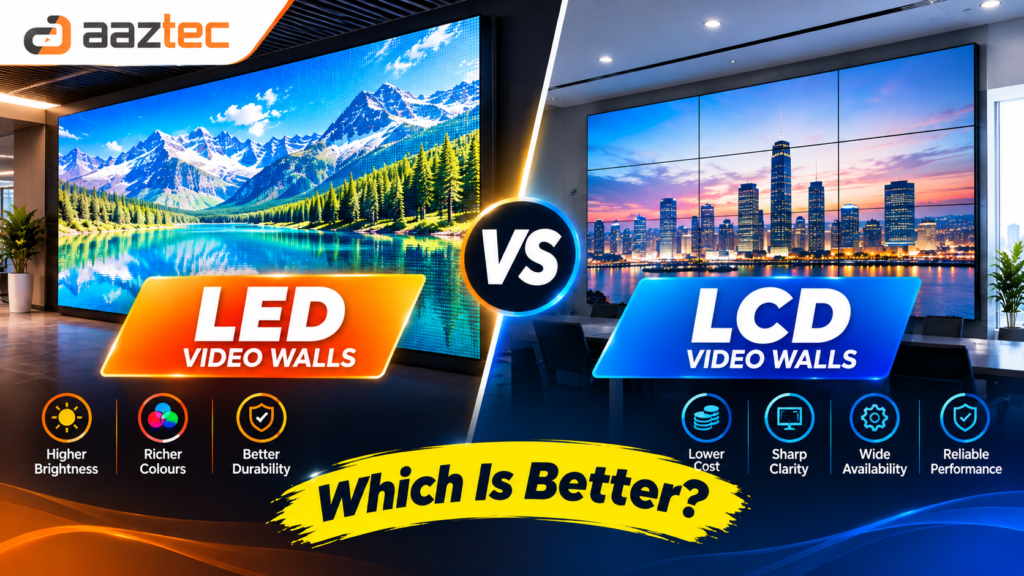
LED vs LCD Video Walls: Which Is better

LED vs LCD Video Walls: Which Is better

When exploring video display solutions, the decision between LED vs LCD video walls can be confusing for businesses new to the industry. Both technologies serve the purpose of creating large-format displays, yet they operate on fundamentally different principles.

What is an LED Video Wall?

LED (Light Emitting Diode) video walls are assembled from individual LED modules that emit their own light. Each module contains thousands of tiny LED pixels arranged in a grid pattern. These pixels work together to create images by emitting colored light directly. At Aaztec, our LED video wall solutions utilize advanced SMD (Surface Mount Device) technology for superior image quality and durability.

What is an LCD Video Wall?

LCD (Liquid Crystal Display) video walls consist of individual LCD panels assembled together using ultra-narrow bezel technology. These panels use a backlight to illuminate liquid crystals that filter light to create images. Unlike LED displays, LCD panels don’t generate their own light—they require an external light source positioned behind the screen matrix.

Key Distinction: LED displays are self-illuminating, while LCD displays rely on backlighting. This fundamental difference influences every aspect of performance, from brightness to energy consumption to scalability.

Display Quality: Brightness & Resolution Comparison

When comparing LED vs LCD video walls, display quality remains a primary consideration for potential buyers.

Brightness Performance

LED Video Walls:

  • LED displays excel in brightness, with outdoor models reaching 5000+ nits
  • Indoor fine-pitch LED options provide 800-2000 nits depending on pixel pitch
  • Superior performance in direct sunlight and brightly lit environments
  • Aaztec’s outdoor LED displays deliver exceptional visibility even in harsh daylight conditions

LCD Video Walls:

  • Typically achieve 300-700 nits brightness
  • Better suited for controlled indoor environments
  • May experience reduced visibility in very bright lighting conditions
  • Aaztec’s LCD video panels are ideal for indoor spaces like corporate lobbies and control rooms

Resolution Capabilities

LED Video Walls:

  • Available in various pixel pitches from P0.9 to P10
  • Fine-pitch options (P1.5-P2) ideal for close viewing distances
  • Coarse-pitch options (P4-P10) suitable for outdoor applications and distant viewing
  • Resolution increases with lower pixel pitch values

LCD Video Walls:

  • Native resolution ranges from 1080p to 4K depending on panel size
  • Ultra-narrow bezel design (as small as 0.88mm) creates seamless visuals
  • Consistent resolution across the entire display
  • Excellent color accuracy and contrast ratios
Feature LED Video Walls LCD Video Walls
Brightness Range 800-5000+ nits 300-700 nits
Pixel Pitch Options P0.9 to P10 Native resolution-based
Best for Close Viewing P1.5-P2 pitch available Excellent with 4K capability
Outdoor Visibility Superior (high nits) Limited in bright sunlight
Color Accuracy Very good Excellent
Contrast Ratio Good Excellent

Screen Size: Scalability & Viewing Distance

One of the most significant advantages when discussing LED vs LCD video walls is their different scalability capabilities.

Modular Scalability

LED Displays:

  • Highly modular—can be assembled to virtually any size or shape
  • Custom configurations for irregular walls, curved installations, and column wraps
  • Pixel pitch determines optimal viewing distance and resolution
  • No fixed size limitations

LCD Displays:

  • Come in standard panel sizes (typically 43″ to 98″)
  • Scaling requires combining multiple standardized panels
  • Bezel gaps create visible lines between panels
  • More limited in terms of creative customization

Viewing Distance Optimization

For LED Video Walls:

  • P2 pitch optimal for 2-3 meters viewing distance
  • P3-P4 pitch ideal for 4-6 meters
  • P5-P10 pitch suitable for outdoor advertising at 10+ meters

For LCD Video Walls:

Installation: Space & Setup Requirements

Installation complexity varies significantly when comparing LED vs LCD video walls for your business environment.

LED Video Wall Installation

Space Requirements:

  • Requires adequate clearance behind the display for heat dissipation
  • Typically 30-50cm of depth needed depending on cabinet specifications
  • Can be mounted on various structural supports
  • Lighter per-unit weight with modular installation

Setup Timeline:

  • Most installations completed within 1-3 days
  • Professional technicians handle calibration and pixel uniformity checks
  • Aaztec’s installation teams cover Delhi NCR, Lucknow, Chandigarh, and across North India with 24-48 hour scheduling

LCD Video Wall Installation

Space Requirements:

  • Less demanding in terms of rear clearance
  • Slimmer profile allows flush wall mounting
  • Heavier per-unit weight (standard LCD panel density)
  • Requires sturdy mounting infrastructure

Setup Timeline:

  • Generally faster than LED installation due to standardized components
  • Bezel gaps require careful planning for content alignment
  • Professional calibration ensures perfect synchronization across panels

Maintenance: Repairs & Reliability

Understanding maintenance requirements is crucial when evaluating LED vs LCD video walls for long-term ownership.

LED Video Wall Maintenance

Reliability Factors:

  • Individual LED modules can be replaced without dismantling the entire display
  • Pixel failure appears as small dark spots—rarely catastrophic
  • Dust accumulation requires periodic cleaning
  • Thermal management systems prevent overheating

Maintenance Schedule:

  • Quarterly inspections recommended
  • Annual professional servicing for optimal performance
  • Spare parts readily available
  • Aaztec provides 3-year warranties covering parts and labor

LED Video Wall Maintenance

Reliability Factors:

  • Entire LCD panel must be replaced if backlighting fails
  • More susceptible to moisture in humid environments
  • Requires climate control in some applications
  • Liquid crystal degradation possible over 5-7 years

Maintenance Schedule:

  • Semi-annual professional inspections
  • Annual alignment and color calibration
  • Component replacement can be more expensive than LED
Aspect LED Video Walls LCD Video Walls
Module Replaceability Individual modules Entire panels
Dust Impact Moderate (periodic cleaning) Moderate (sealed)
Heat Management Active cooling required Passive cooling possible
Climate Sensitivity Heat-resistant Moisture-sensitive
Average Lifespan 5-10 years (depending on usage) 5-7 years
Warranty Coverage Typically 3 years Typically 2-3 years

Cost Comparison: Initial & Long-Term Costs

Budget considerations often determine the choice between LED vs LCD video walls for many organizations.

Initial Purchase & Installation Costs

LED Video Walls:

  • Fine-pitch LED (P2-P2.5): ₹1,20,000 onwards per square meter
  • Coarse-pitch outdoor LED (P4-P6): ₹60,000-₹80,000 per square meter
  • Installation costs: ₹15,000-₹30,000 depending on complexity
  • Structural requirements may add 10-15% to project costs

LCD Video Walls:

  • 43″ LFD: ₹40,000-₹70,000 per unit
  • 55″ panels: ₹70,000-₹1,20,000 per unit
  • 98″ LFD: ₹2,00,000-₹3,50,000 per unit
  • Installation costs: ₹10,000-₹20,000 (generally lower due to standardization)

Long-Term Operating Costs

LED Video Walls:

  • Power consumption: 300-500W per square meter
  • Annual electricity cost for 8-hour daily operation: ₹5,000-₹8,000 per square meter
  • Maintenance costs: ₹8,000-₹15,000 annually

LCD Video Walls:

  • Power consumption: 150-250W per square meter
  • Annual electricity cost for 8-hour daily operation: ₹2,500-₹4,000 per square meter
  • Maintenance costs: ₹10,000-₹18,000 annually (higher due to panel complexity)

Applications: Indoor & Outdoor Uses

Practical applications significantly differ when considering LED vs LCD video walls.

Best Applications for LED Displays

Outdoor Environments:

  • Digital billboards and outdoor advertising hoardings
  • Stadium and sports arena displays
  • Building façade lighting and artistic installations
  • Public transportation hubs (bus terminals, railway stations)
  • Large-scale outdoor events and concert productions

Indoor Environments:

Best Applications for LCD Displays

Indoor Environments:

  • Corporate conference rooms and boardrooms
  • Hospital and healthcare facility displays
  • Educational institution classrooms and lecture halls
  • Retail point-of-sale displays and digital menu boards
  • Office lobby information systems
  • Stretch monitors for retail shelving

Limited Outdoor Use:

  • Covered outdoor spaces with controlled brightness
  • Digital signage in shaded areas
  • Indoor-outdoor transitional spaces

Energy Efficiency: Power Consumption

Energy consumption represents an important consideration for sustainable operations when evaluating LED vs LCD video walls.

LED Display Power Efficiency

Power Characteristics:

  • Brightness-dependent consumption (brighter content uses more power)
  • Average consumption: 300-500W per square meter
  • Dynamic power management reduces consumption during low-brightness content
  • Heat generation requires active cooling systems

Energy-Saving Features:

  • Advanced power supplies with high efficiency ratings
  • Automatic brightness adjustment based on ambient light
  • Modular design allows partial operation if needed

LCD Display Power Efficiency

Power Characteristics:

  • More consistent power consumption regardless of content
  • Average consumption: 150-250W per square meter
  • Lower thermal output reduces cooling requirements
  • Fixed backlighting consumes power continuously

Energy-Saving Features:

  • LED backlighting options available (more efficient than traditional CCFL)
  • Sleep mode activation during standby periods
  • Central power management across multiple panels

Important Note: While LCD displays consume less power per square meter, this advantage diminishes when considering LED’s brightness requirements for outdoor applications. The total cost of ownership depends on your specific use case and environmental factors.

Which Is Better? Choosing the Right Option

The answer to “LED vs LCD video walls—which is better?” depends entirely on your specific requirements, budget, and application environment.

Choose LED Video Walls If:

✓ You need outdoor visibility in bright sunlight conditions ✓ You require custom sizing or creative curved installations ✓ Close-range viewing is anticipated (3-6 meters) ✓ You prioritize modular component replacement ✓ You need maximum brightness (800+ nits) ✓ Longevity and impact are key priorities ✓ You have adequate space for heat dissipation

Choose LCD Video Walls If:

✓ Your application is strictly indoor with controlled lighting ✓ You need standardized panel sizes and configurations ✓ Lower initial setup and infrastructure costs are priorities ✓ You have limited space for equipment depth ✓ Energy efficiency is a primary concern ✓ You prefer established supply chains and standardized support ✓ Color accuracy and contrast ratios are critical

Decision-Making Framework

  1. Environment Assessment: Is your application indoor or outdoor?
  2. Brightness Requirement: Do you need 800+ nits or less than 700?
  3. Budget Analysis: What’s your total cost of ownership (initial + 5-year operating costs)?
  4. Space Evaluation: How much depth is available for installation?
  5. Scalability Needs: Will you need to expand or reconfigure the display?
  6. Support Requirements: What level of maintenance and support do you require?

Conclusion

As India’s leading digital display manufacturer, Aaztec specializes in providing both LED and LCD video wall solutions tailored to your specific requirements. With over 10 years of experience and 500+ successful installations across North India, our team understands the nuances of choosing between these technologies.

Whether you’re installing an indoor LED video wall for your corporate lobby, deploying an outdoor LED display for digital advertising, or configuring an LCD video wall for your control room, Aaztec provides factory-direct pricing, professional installation, and comprehensive after-sales support.

Ready to make your decision? Contact Aaztec today for a free consultation and customized quotation. Our experts will analyze your requirements and recommend the optimal display solution—whether LED or LCD—to maximize your return on investment.

Contact Aaztec Today

  • Phone: +91-9125161262
  • Email: sales@aaztecsolution.com
  • Location: 646 Pace City 2, Sector 37, Gurgaon, Haryana
  • Service Coverage: Delhi NCR, Lucknow, Chandigarh, Dehradun, and across North India

Frequently Asked Questions (FAQs)

1. What is the best pixel pitch for indoor LED displays?

For indoor corporate environments, P2-P2.5 LED video walls provide optimal image quality when viewing distances range from 2-4 meters. Aaztec’s fine-pitch LED displays deliver crystal-clear visuals ideal for boardrooms and presentation spaces.

LCD displays can function in covered outdoor spaces with ambient lighting control, but they cannot match LED brightness for direct sunlight applications. For true outdoor durability, LED outdoor displays with IP65 weatherproofing are the recommended solution.

LED video wall pricing in India ranges from ₹60,000 per square meter for outdoor coarse-pitch displays (P4-P6) to ₹1,20,000+ per square meter for fine-pitch indoor displays (P2-P2.5). Aaztec offers customized quotes based on specific project requirements.

P2.5 (2.5mm pixel pitch) provides higher resolution suitable for close viewing (3-4 meters), while P4 (4mm pitch) is designed for viewing distances of 6+ meters. The larger the pixel pitch number, the lower the resolution but the greater the viewing distance capability.

Yes, Aaztec offers comprehensive LED video wall rental services across Delhi NCR, Lucknow, Chandigarh, and throughout North India. Rental packages include equipment, professional installation, on-site technician support, and complete dismantling.

Contact form