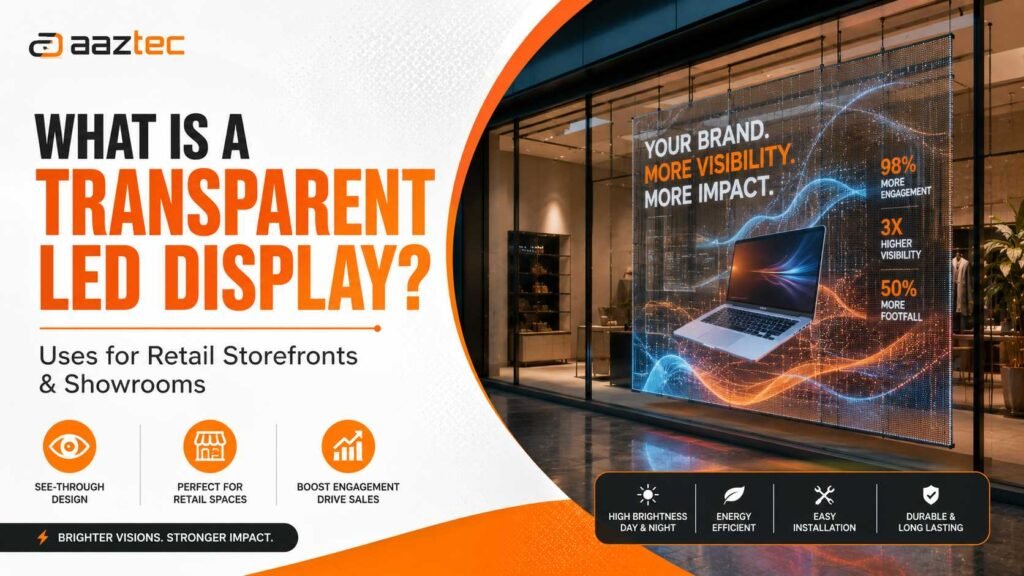
What is a Transparent LED Display? Uses for Retail Storefronts & Showrooms
How Do You Decide Between Two Close Pixel Pitch Options, Like P3 and P4?
Walk past any big showroom or high-street store today, and you may notice something new — a glass window that is also a glowing video screen. You can see the products behind the glass, and at the same time, a video plays right on top of it. In this blog, we answer the most common question people ask: what is a transparent LED display, and why more retail brands are choosing it for their storefronts and showrooms.
What is a Transparent LED Display?
A transparent LED display is a type of LED screen that lets light and visibility pass through it, just like glass, while still showing bright video, images, and text. Unlike a normal LED video wall, which is a solid, closed panel, a transparent LED display uses thin LED strips fixed onto glass or a light frame in a mesh-like structure. This leaves gaps between the LED lights, so people can see through the screen from both sides.
In simple words, a transparent LED display works like a window and a digital screen at the same time. Customers walking outside your store can see the products on display and also watch moving content, offers, or brand videos on the same glass.
This is different from a transparent OLED display, which uses organic light-emitting diode technology and is mostly used for small indoor screens like kiosks. Transparent LED screens are brighter and better suited for large storefronts and outdoor-facing windows because they can handle sunlight and bigger sizes.
How Does a Transparent LED Display Work?
A transparent LED panel is built using a strip or mesh structure where LED chips are placed at set gaps and mounted on a glass panel or a slim frame. Because there is open space between each LED line, natural light and eyesight pass through freely. Only about 10–15% of the surface is actually covered by LEDs; the rest stays clear.
This is what gives the display its “see-through” quality, known as transparency percentage. A higher transparency percentage means clearer visibility of what is kept behind the glass, while a lower one usually means brighter, sharper video output.
Why is Transparency Percentage Important?
Most retail-grade transparent LED displays offer 65% to 90% transparency. Here is why this number matters for your store:
Higher transparency (80–90%): Best when you want shoppers to clearly see mannequins, products, or interiors behind the glass, with light video overlays.
Medium transparency (65–75%): A good balance between visible content behind the glass and stronger, brighter video display.
Lower transparency: Rarely used for storefronts since it blocks natural light and product view, but may suit indoor branding walls.
The right choice depends on your storefront design and what you want customers to focus on first — the product or the screen.
What Are the Main Uses of Transparent LED Displays for Retail Storefronts?
Retail brands are adopting transparent LED displays quickly because they solve a real problem — traditional LED video walls block the view of the shop window completely. Here are the main uses:
Storefront Window Advertising — Instead of covering your glass window with vinyl posters, a transparent LED display lets you run moving advertisements, seasonal offers, and new arrivals while the window display remains fully visible.
Brand Storytelling Without Blocking the View — Fashion, jewellery, and electronics stores use transparent LED panels to play short brand videos or product highlights, while customers can still window-shop and see the actual merchandise.
Attracting Footfall From the Street — A moving, glowing display naturally draws more attention than a static poster. Malls and high-street stores use this to stop passers-by and pull them inside.
Showroom Glass Partitions — Car showrooms, real estate offices, and premium retail brands use transparent LED glass as an indoor partition, separating sections of the showroom while keeping the space open and airy.
Combining Digital Signage With Physical Display — Retailers sync transparent LED content with in-storedigital signage systems, so offers shown on the window match promotions inside the store.
Why Are Transparent LED Displays Good for Showrooms?
Showrooms — for cars, furniture, or fashion — depend heavily on how a product looks under natural light. A solid LED video wall would block this completely. A transparent LED display solves this by:
Letting natural daylight enter, keeping the space bright and welcoming
Showing product specifications, pricing, or promotional videos next to the actual product
Creating a premium, modern look that matches high-endretail branding
Reducing the need for separate signage boards, since content plays directly on the glass
Is a Transparent LED Display Different From a Normal LED Video Wall?
Yes. A regularLED video wall is built with closed cabinets and solid modules — no light passes through it. A transparent LED display is built differently, using open mesh strips on glass, so it can be viewed from both sides and allows light through it. A quick comparison:
Feature
Transparent LED Display
Standard LED Video Wall
See-through
Yes
No
Ideal placement
Windows, glass partitions
Solid walls, stages
Brightness needed
Higher (to beat outdoor light)
Standard
Best for
Storefronts, showrooms
Events, control rooms, auditoriums
What Should You Check Before Installing a Transparent LED Display?
Before you install a transparent LED screen at your store or showroom, keep these points in mind:
Transparency percentage – decide based on how much of the background you want visible.
Brightness (nits) – outdoor-facing windows need higher brightness to stay visible in daylight.
Pixel pitch – closer pixel pitch gives sharper video but slightly reduces transparency.
Installation method – confirm whether your glass window can support the mounting frame, or if it needs a new glass structure.
Content management – check if the display supports remote content updates, so offers can be changed without a technician visit.
Energy efficiency – LED displays use less power than older signage methods; general guidelines are available on theBureau of Energy Efficiency website.
Quality standards – prefer displays that follow recognised electronics benchmarks, as outlined by theBureau of Indian Standards.
Final Thoughts
So, what is a transparent LED display, really? It is a smart mix of glass and screen — a display that lets your store stay visible while still giving you a powerful digital advertising tool. For retail storefronts and showrooms, it solves an old problem: how to advertise digitally without hiding what you are selling. Whether it is a fashion outlet, a car showroom, or a mall storefront, this technology helps brands stay visible, modern, and eye-catching, day and night.
If you are planning to upgrade your store window or showroom glass, it helps to work with a manufacturer who understands both the technical side and the retail experience. Browse Aaztec full range ofLED display solutions, check how other brands have used LED displays in ourcase studies, or reach out through oursupport page for sizing and pricing queries.
John Doe@username
Lorem ipsum dolor sit amet, consectetur adipiscing elit. Ut elit tellus, luctus nec ullamcorper mattis, pulvinar dapibus leo.
John Doe@username
Lorem ipsum dolor sit amet, consectetur adipiscing elit. Ut elit tellus, luctus nec ullamcorper mattis, pulvinar dapibus leo.
John Doe@username
Lorem ipsum dolor sit amet, consectetur adipiscing elit. Ut elit tellus, luctus nec ullamcorper mattis, pulvinar dapibus leo.
John Doe@username
Lorem ipsum dolor sit amet, consectetur adipiscing elit. Ut elit tellus, luctus nec ullamcorper mattis, pulvinar dapibus leo.
John Doe@username
Lorem ipsum dolor sit amet, consectetur adipiscing elit. Ut elit tellus, luctus nec ullamcorper mattis, pulvinar dapibus leo.
John Doe@username
Lorem ipsum dolor sit amet, consectetur adipiscing elit. Ut elit tellus, luctus nec ullamcorper mattis, pulvinar dapibus leo.