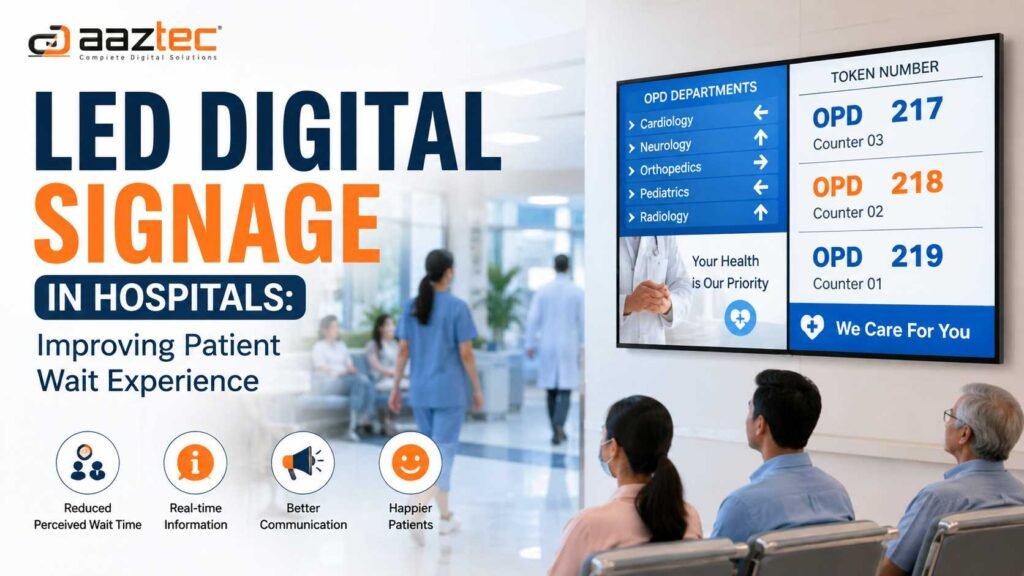
LED Digital Signage in Hospitals: Improving Patient Wait Experience
Walk into any busy hospital OPD in India, and you’ll see the same scene — crowded waiting areas, confused patients, and staff repeating the same instructions again and again. This is exactly where LED digital signage in hospitals is changing the game. By replacing static notice boards with smart, real-time screens, hospitals can directly improve the patient wait experience — making waiting rooms feel calmer, more organised, and far less stressful.
What Is LED Digital Signage in Hospitals?
LED digital signage in hospitals refers to electronic display screens — LED video walls, LFD panels, or interactive flat panels — installed across waiting areas, corridors, pharmacy counters, and reception desks. Unlike a printed poster, these screens can be updated instantly with token numbers, doctor availability, health tips, and emergency alerts.
Instead of static information that goes out of date within days, hospitals get a live communication system that talks to patients in real time.
Why Does Patient Wait Experience Matter So Much?
Waiting is one of the biggest sources of patient dissatisfaction in Indian hospitals. When patients don’t know how long they’ll wait or why there’s a delay, anxiety builds up quickly. This affects not just patient mood but also how the hospital is perceived overall.
A better patient wait experience leads to:
Lower patient frustration and complaints
Fewer questions directed at front-desk staff
A more professional, trustworthy hospital image
Better patient satisfaction scores, which matter for accreditation
This is precisely the gap that LED digital signage in hospitals is designed to fill.
How Does LED Digital Signage Improve Patient Wait Experience?
Does Digital Signage Reduce the Feeling of Long Waits?
Yes. Studies on queue psychology consistently show that unexplained waiting feels longer than explained waiting. When a screen shows the current token number, doctor’s name, and estimated wait time, patients feel more in control — even if the actual wait time doesn’t change.
Can Digital Signage Replace Manual Announcements?
Largely, yes. Instead of staff calling out names or token numbers repeatedly, a queue management display paired with LED signage can show this information visually and clearly, reducing noise and confusion in the waiting area. Hospitals already usingqueue management systems can pair them directly with LED screens for a complete, automated patient-calling experience.
What Kind of Content Should Hospitals Show on These Screens?
Hospitals typically use LED digital signage to display:
Live token numbers and doctor room allocations
Estimated waiting time per department
Health awareness content (hygiene tips, seasonal illness alerts)
Emergency and safety instructions
Wayfinding directions to departments like radiology, pharmacy, or billing
Hospital achievements, certifications, and doctor introductions
This mix keeps patients informed and mentally engaged instead of just staring at a blank wall.
Where Can Hospitals Use LED Digital Signage?
Is It Only for the Main Waiting Area?
Not at all. LED digital signage in hospitals works well across multiple zones:
OPD waiting halls — token and doctor availability updates
Pharmacy counters — order status and pickup alerts
Emergency and triage areas — real-time safety instructions
Main lobby and reception — wayfinding and general announcements
Cafeteria and family waiting zones — health tips and hospital updates
Each of these zones has a slightly different patient need, so screen placement and content should be planned accordingly.
What Type of Display Works Best for Hospitals?
Should Hospitals Choose an LED Video Wall or a Flat Panel?
It depends on the space. Large lobbies and OPD halls with high footfall benefit from biggerLFD displays, which offer bright, clear visuals visible from a distance. For smaller counters like pharmacy or billing, a compact interactive panel works better.
Are Touch-Based Screens Useful in Hospitals?
Yes, especially for self-check-in kiosks or wayfinding maps. Hospitals looking to modernise patient interaction can also exploreinteractive flat panels, which allow patients to search for departments or doctor schedules themselves, reducing pressure on the front desk.
Do Hospitals Need Special Software to Run These Screens?
Yes. Content on hospital displays needs to be managed centrally and updated in real time. A properdigital signage software setup allows hospital staff to push updates — like a doctor running late or an emergency alert — instantly across all connected screens, without needing to be physically present at each unit.
What Should Hospitals Look for Before Installing Digital Signage?
Before choosing an LED digital signage provider for healthcare, hospitals should consider:
Brightness and readability — waiting areas are often brightly lit, so screens need sufficient brightness for clear visibility.
Reliability — hospitals run 24×7, so displays need to be built for continuous operation without frequent downtime.
Easy content management — non-technical hospital staff should be able to update information without IT support.
Integration with queue systems — signage should connect smoothly with token and appointment systems already in use.
After-sales support — since these screens run constantly, quick maintenance response matters more in healthcare than almost any other setting.
Aaztec designs LED and LFD display solutions specifically suited forhealthcare environments, factoring in continuous run-time, easy content updates, and integration with hospital queue systems — all backed by pan-India installation and support.
According to theMinistry of Health and Family Welfare’s guidelines on patient-centric care, improving communication and reducing perceived waiting time are recognised as key components of overall patient experience in healthcare facilities — reinforcing why hospitals are increasingly investing in digital communication tools like LED signage.
1. What is the main benefit of LED digital signage in hospitals?
The biggest benefit is improved patient wait experience — patients feel informed and less anxious when they can see real-time updates on token numbers, doctor availability, and wait times.
2. Which hospital areas benefit most from digital signage?
OPD waiting halls, pharmacy counters, emergency zones, and main lobbies see the highest impact, since these are the areas with the most patient footfall and queuing.
3. Can digital signage be connected to a hospital's queue management system?
Yes. LED and LFD screens can be integrated with queue management setups to automatically display live token numbers, removing the need for manual announcements.
4. Is LED digital signage expensive to maintain in a hospital setting?
With the right display quality and an Annual Maintenance Contract (AMC), running costs stay predictable. Hospitals should prioritise displays built for continuous, 24×7 operation to avoid frequent repairs.
5. Can small hospitals or clinics also use LED digital signage?
Absolutely. Even a single interactive panel or compact LFD screen at the reception can significantly improve communication and patient wait experience in smaller clinics.
John Doe@username
Lorem ipsum dolor sit amet, consectetur adipiscing elit. Ut elit tellus, luctus nec ullamcorper mattis, pulvinar dapibus leo.
John Doe@username
Lorem ipsum dolor sit amet, consectetur adipiscing elit. Ut elit tellus, luctus nec ullamcorper mattis, pulvinar dapibus leo.
John Doe@username
Lorem ipsum dolor sit amet, consectetur adipiscing elit. Ut elit tellus, luctus nec ullamcorper mattis, pulvinar dapibus leo.
John Doe@username
Lorem ipsum dolor sit amet, consectetur adipiscing elit. Ut elit tellus, luctus nec ullamcorper mattis, pulvinar dapibus leo.
John Doe@username
Lorem ipsum dolor sit amet, consectetur adipiscing elit. Ut elit tellus, luctus nec ullamcorper mattis, pulvinar dapibus leo.
John Doe@username
Lorem ipsum dolor sit amet, consectetur adipiscing elit. Ut elit tellus, luctus nec ullamcorper mattis, pulvinar dapibus leo.